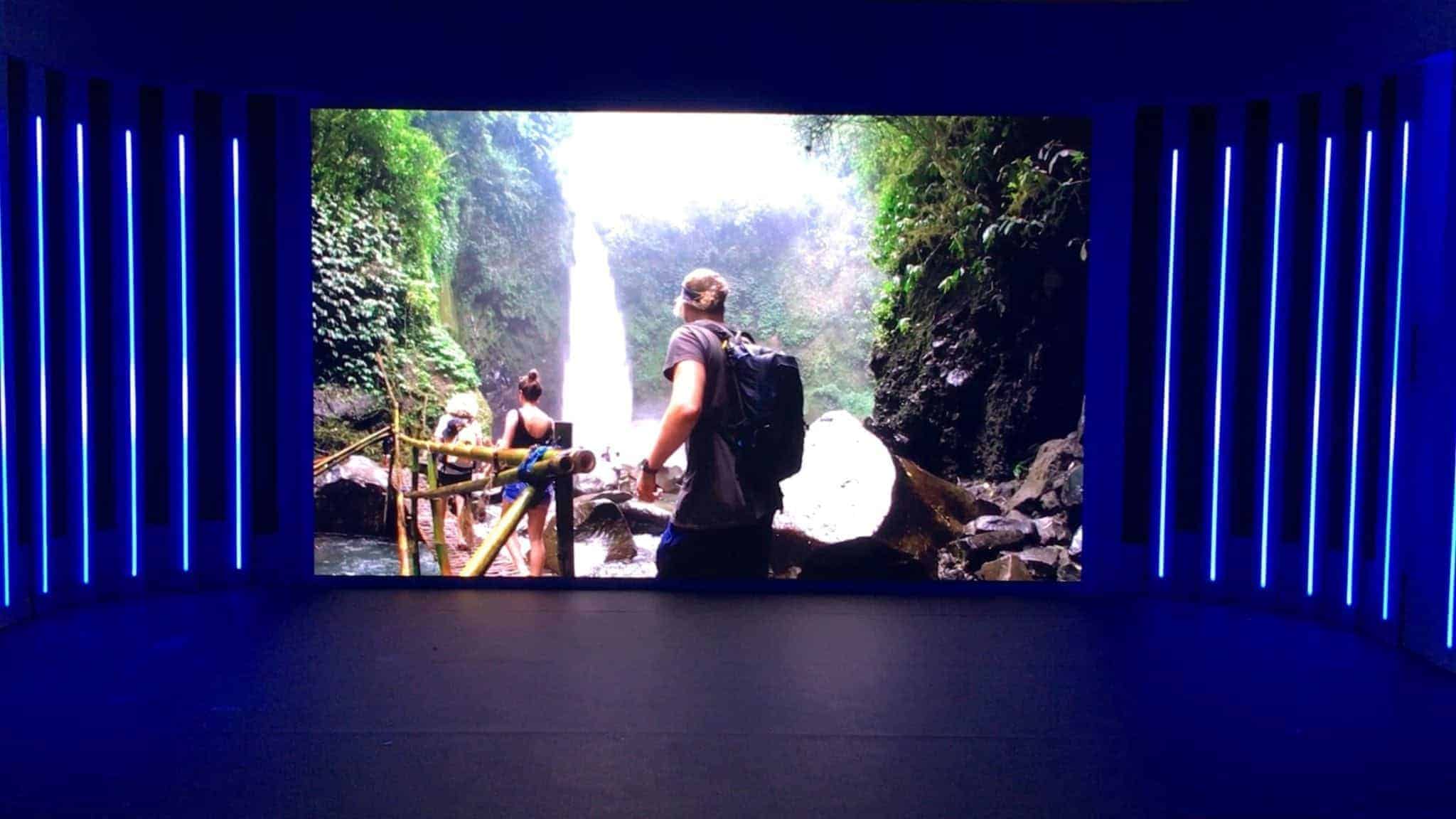
Dynamo LED Displays built a 4.8 m wide by 2.88 m high 2.5mm pixel pitch LED screen for a London spinning studio from 60 indoor LED cabinets, with LED strip lightboxes either side, so classes work out in front of moving scenery instead of a projector image washed out by the studio lighting.
Updated September 2026. Case study first published January 2018.
Project facts
| Venue | Boutique indoor cycling (spinning) studio, London |
|---|---|
| Screen | 4.8 m wide by 2.88 m high indoor LED video wall |
| Pixel pitch | 2.5mm |
| Build | 60 indoor LED cabinets in a 10 by 6 grid |
| Lighting | LED strip lightboxes either side of the screen, run with the class |
| Content | Scenic and motion-graphic video played during classes; the wall doubles as a backdrop |
| Scope | Supply, installation and commissioning by Dynamo LED Displays |
The brief: a class that rides through scenery
Boutique spin studios sell an experience, not a room of bikes. This studio wanted the whole end wall to move with the class, from mountain roads to abstract beat-driven graphics, in a room that is deliberately dark with strong coloured lighting. A projector struggles there: the beam is blocked by the instructor and the image loses contrast as soon as the lights come up. A direct-view indoor LED display has no throw distance and keeps its blacks under stage lighting.
What Dynamo installed
Sixty cabinets, one 4.8 m wall
The screen is built from 60 of Dynamo’s indoor LED cabinets in a 10 by 6 grid, giving a 4.8 m by 2.88 m surface that fills the end wall between the side lightboxes. A 16:9-ish canvas at that size lets the studio play standard widescreen footage without cropping.
Why 2.5mm
The front row of bikes sits within a few metres of the wall, so the pitch had to be fine enough that riders do not see the individual LEDs while pedalling at it for 45 minutes. At 2.5mm the picture reads as continuous from about 2.5 m, which matched the first row. A coarser 3.9mm cabinet would have been cheaper but visibly pixelated from the front bikes.
LED strip lightboxes either side
Vertical LED strip lightboxes on both side walls carry the colour of the content into the room, so a blue underwater sequence or a red climb section lights the riders as well as the screen. They are driven with the class so instructors can change the mood between tracks.
Content and control
Class content is scheduled and pushed to the wall through Dynamo’s content management workflow, so the studio adds new rides without an engineer on site. The same wall shows the studio’s branding between classes and works as a backdrop for launches and filming.
Current Dynamo options for a gym or studio LED wall
The figures below are from the DX Series datasheet, the fixed-install indoor range Dynamo specifies for studios and gyms today.
| Model | Pixel pitch | Module | Brightness | Refresh rate | Suited to |
|---|---|---|---|---|---|
| DX2.5 | 2.5mm | 250 × 250 mm, 100 × 100 px | 800 nits or more | 3,840 Hz or more | Spin and HIIT studios with bikes close to the wall |
| DX2.9 | 2.9mm | 250 × 250 mm, 84 × 84 px | 800 nits or more | 3,840 Hz or more | Larger gym floors viewed from 3 m or more |
| DX3.9 | 3.9mm | 250 × 250 mm, 64 × 64 px | 800 nits or more | 3,840 Hz or more | Sports halls and reception walls viewed from a distance |
The 3,840 Hz refresh rate matters in a studio because classes are filmed and streamed; a low refresh rate shows as banding on camera. For a full wall build-up see LED video walls.
Related Dynamo projects
- Big TV hire for the Fiit app at a London gym
- Sports bar LED screens: what to specify
- Immersive LED room for Mount Anvil
- LED screen hire for launch events and pop-up classes
LED screens for fitness studios: frequently asked questions
What size LED screen does a spin studio need?
Size the screen to the wall and the room, not to a TV format. This London studio used the full end wall, 4.8 m by 2.88 m, so every bike faces the picture. Cabinets are built in 250 mm or 500 mm steps, so the wall can be any multiple of those in each direction, and a narrower room simply uses fewer columns of cabinets.
Which pixel pitch suits a gym or fitness studio?
Take the distance from the nearest bike or mat to the wall. Riders 2 m to 3 m away need 2.5mm or finer so the LEDs merge into a picture; a gym floor viewed from 3 m or more works at 2.9mm to 3.9mm. Finer pitch costs more per square metre, so spend it only where people are close.
Is an LED wall better than a projector for a fitness studio?
In a dark studio with coloured lighting, yes. A projector needs a clear throw path, so the instructor casts a shadow, and its image fades when the lights come up. A direct-view LED wall sits flat on the wall, holds contrast under stage lighting, and runs for years without lamp changes. The trade-off is a higher upfront cost.
How bright should a studio LED screen be?
Indoor cabinets rated at 800 nits or more, the DX Series datasheet figure, are ample for a studio and are normally dimmed for classes so the wall does not glare at riders in a dark room. Brightness only needs to rise for rooms with daylight or for a screen behind a reception desk facing windows.
Can the studio update the content itself?
Yes. Content is scheduled through the cloud content management system, so a studio manager uploads a new ride or a promotional loop from a laptop and it plays at the next class. Instructors can switch between pre-loaded sequences during a session, and the LED strip lightboxes can be set to follow the content colour.
Get a quote for a fitness studio LED screen
Send us the wall dimensions, the distance to the nearest bike or mat and a photo of the room, and we will come back with a pixel pitch, a cabinet layout and a written quote. Get a quote or call 020 3489 9878.